A Service Designer and Design Researcher,
a Systems Thinker, and a Curious Explorer!


Long Term Care @ Home
Dip Your Toes
Overview:
A service design project commissioned by the BC Ministry of Health to shape the Long-term Care at Home program, now supporting hundreds of seniors across BC with plans to reach 2,700 by 2028. By designing and leading a co-creation process with 40 cross-sector health stakeholders, the project uncovered a critical mismatch between the proposed service model and the realities of seniors' conditions, preventing a $2M investment in an inaccessible service and redirecting the strategy toward a preventative, home-based care model that seniors could actually use.
5 months
Duration
Client
BC Ministry of Health
My Role
Service Designer
2 Facilitators
2 Designers
Team

Achievement
preventing a $2M investment in an inaccessible service
My Contributions and Impact:
-
Challenged the Ministry's plan to validate a pre-designed service through Q&A and proposed a blue sky co-creation process instead, allowing critical gaps in the service model to surface that would have otherwise gone undetected
-
Designed and co-facilitated a co-creation session with 40 cross-sector health stakeholders, using personas, service blueprinting, and visual cards to ground policy-level thinking in real seniors' experiences and generate insights that redirected the strategic direction of the service
-
Uncovered a critical mismatch between the proposed service model and seniors' actual needs and capabilities, leading to a fundamental redesign from a treatment-focused model to a preventative approach that seniors could realistically use
-
Directly contributed to the development of what became LTC@Home, a provincial program that launched in 2024 and is now expanding to support up to 2,700 seniors across BC with $47 million in funding
Methods & Tools:
-
Personas
-
Service blueprinting
Visual Prompt Cards
Blue sky co-creation
-
Structured workbook design
-
Multi-stakeholder facilitation
Highlight: Moving Beyond Validation Seeking Engagements
When the Ministry proposed presenting their pre-designed service to stakeholders for Q&A feedback, I raised a concern. Showing participants an existing solution would anchor their thinking and prevent new insights from emerging. Instead I proposed a blue sky co-creation session where participants mapped out the ideal virtual care journey from scratch, without any reference to what had already been designed.
This decision changed the outcome entirely. What emerged was a critical finding: the seniors the service was designed for were too unwell to independently use the digital tools it depended on, a flaw the Ministry's validation approach would never have surfaced.


Questioning the Approach
The Ministry of Health arrived with a pre-designed virtual care service and a plan to validate it through Q&A with 40 cross-sector health stakeholders. I recognized a critical flaw in this approach. Once stakeholders saw the existing service, their thinking would be constrained by what was already presented, making it impossible for them to imagine what could actually work given the realities of seniors' health, capabilities, and the existing BC health system resources available to support them at home.
Instead, I proposed a blue sky co-creation process where stakeholders would collectively imagine an ideal long-term care at home service from scratch, drawing on their direct knowledge of how home care, community health, assisted living, and palliative care services could be integrated into a coherent system for seniors.
Reframing Co-Creation as Leadership, Not Abdication
When I proposed a blue sky co-creation session instead of validating the Ministry's pre-designed service, their initial concern was understandable. They worried that starting from scratch would signal to stakeholders that the Ministry hadn't done their work, that they were unprepared and dumping responsibility onto others. Co-creation risked looking like a lack of leadership.
But this framing missed something crucial. Co-creation is not about the Ministry stepping back because they have not done their work. It is about the Ministry stepping forward in a different way. By inviting stakeholders to imagine the ideal service from scratch, the Ministry was saying: your expertise and your knowledge of seniors' real needs are so valuable that we want them shaping this service at the design stage, not validating it at the end.
This reframe changed the entire approach. Co-creation became a statement of respect and intentional design leadership, not a sign of weakness or resource constraint.With that clarity, the co-creation session became possible.
Designing for Reflection and Collective Imagination
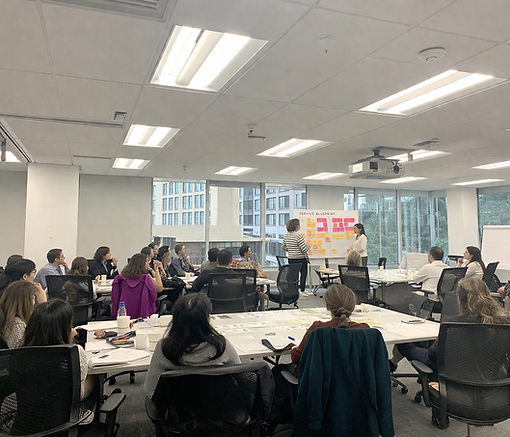
The session was designed in two parts. The first part moved participants through three modes of collaboration, starting with individual reflection, then paired discussion, and finally full group co-creation at the table. This ensured every voice was heard before group dynamics took over. The second part brought the whole room together to share insights across tables and identify patterns emerging from the collective imagination of all participants.
Each part was supported by a set of tools designed to help participants think concretely about seniors' lived realities rather than abstractly about service design.
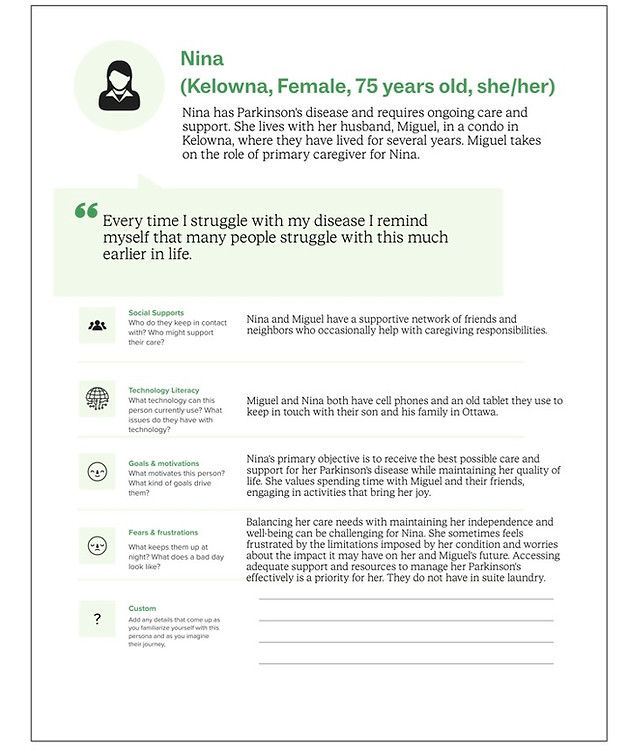
Personas
Four personas representing real senior experiences across BC were developed to give participants a human centered starting point. Each persona had a distinct health condition, level of technology literacy, social support network, and set of fears and motivations. Rather than thinking in policy abstractions, participants were asked to speak in first person from each persona's perspective, making seniors' realities present in the room before any ideation began.
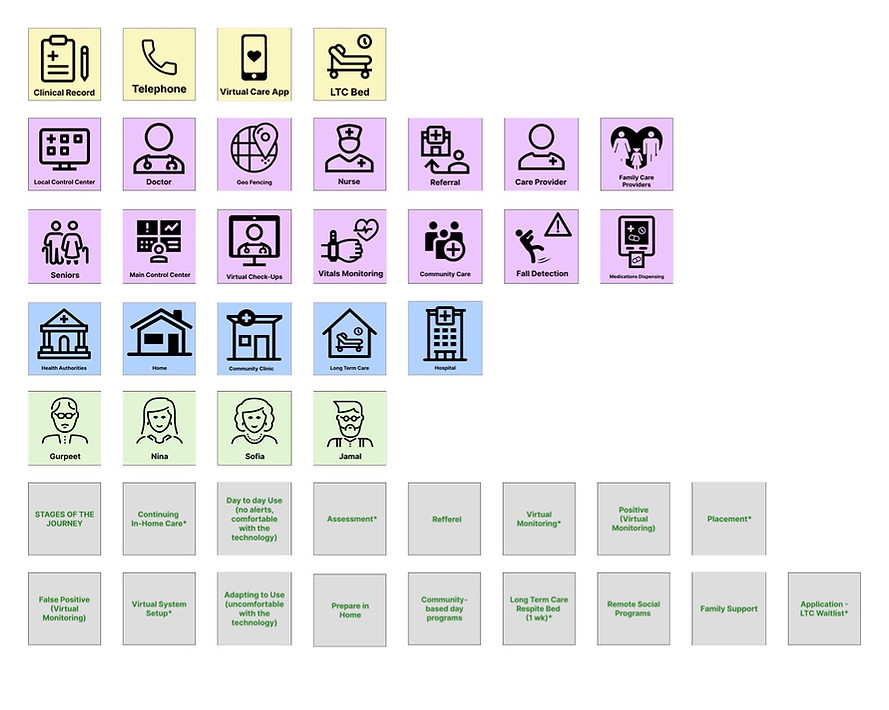
Visual Prompt Cards
A set of illustrated cards representing the people, places, technologies, and service stages relevant to virtual seniors care were used as props throughout the session. These gave participants something tangible to work with as they built and narrated scenarios, helping them think concretely about the service journey rather than abstractly about policy.
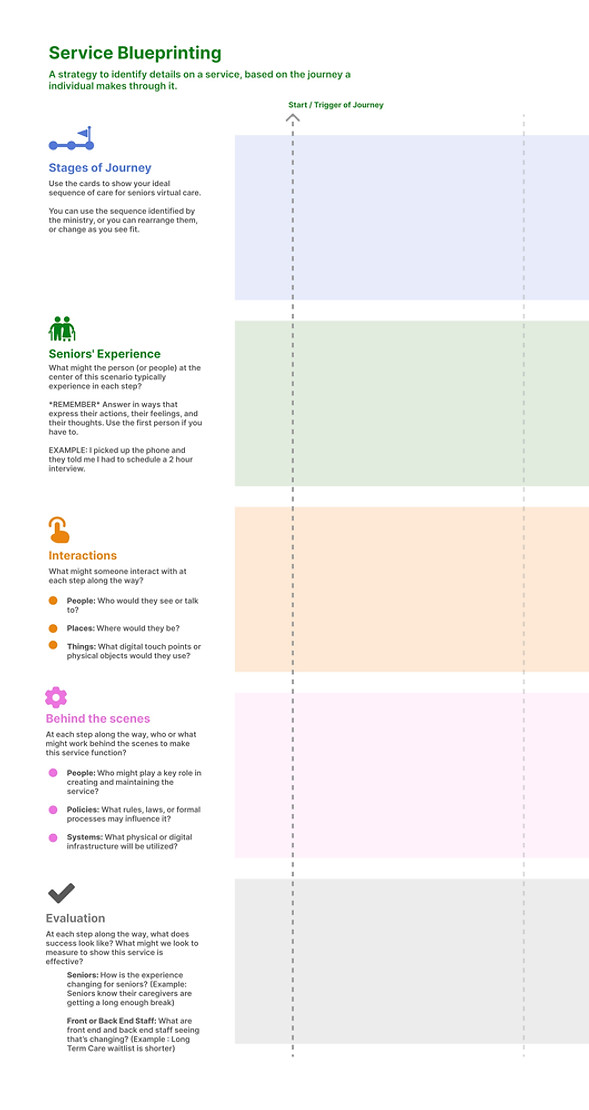
Service Blueprint
A physical service blueprint laid out on each table guided participants through mapping the ideal senior care journey stage by stage. Working in groups, participants added post-it notes capturing seniors' experiences, emotions, interactions, and touchpoints at each stage of the journey.
Participants' Workbook
We designed a workbook that helped participants reflect on different aspects of the LTC @ Home project. I highly recommend engaging with the workbook to see the co-creation session I helped design for this project.
Application is no longer available.
Together these tools moved participants from individual reflection to collective imagination, creating the conditions for insights that the Ministry's original approach would never have reached. Due to a non-disclosure agreement, the participants' notes and session outputs cannot be shared here.
What Emerged From the Room
The co-creation session brought together 40 cross-sector health stakeholders divided into four tables, each working through the service blueprint using personas and visual prompt cards to map out the ideal virtual care journey for seniors.
What emerged challenged the fundamental assumptions the service had been built on. As participants mapped the senior's journey stage by stage, it became clear that the seniors eligible for long-term care had health needs so complex that they could not independently use the digital tools the service depended on.
This insight did not come from the design team. It surfaced from the collective knowledge of the stakeholders in the room, which was precisely what the co-creation process was designed to enable.

What Changed
The session revealed that the proposed service model was fundamentally misaligned with the realities of its intended users, leading the Ministry to redesign the service from the ground up. Rather than replicating long-term care in the home for seniors with complex care needs, the service was redirected toward a preventative model that supported seniors earlier, before their health declined to the point where digital tools became inaccessible.
That strategic shift became LTC@Home, a provincial program that launched in 2024 and is now expanding to support up to 2,700 seniors across BC with $47 million in funding.